

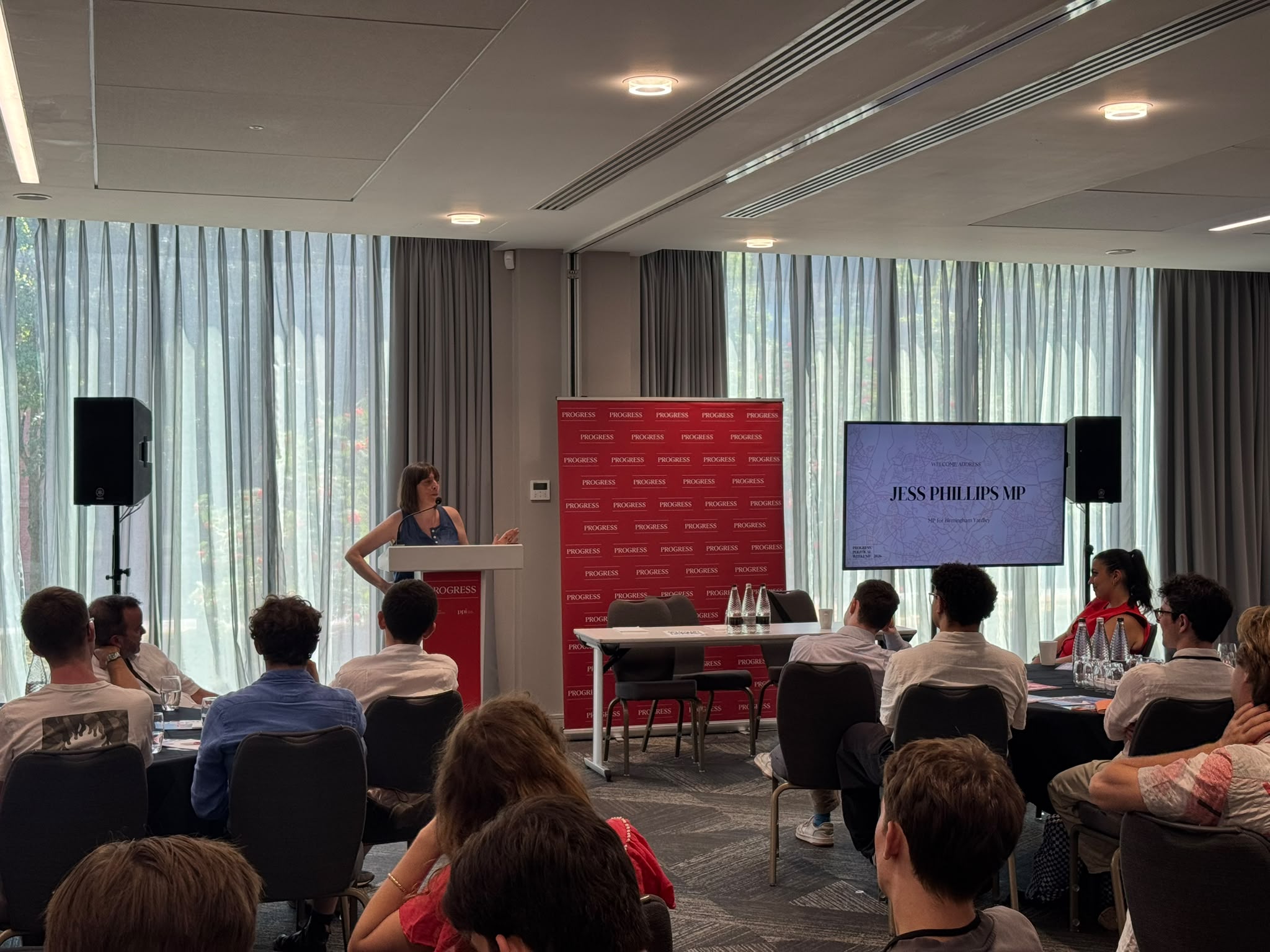
In July I had the wonderful opportunity of attending Progress’ Political Weekend in Birmingham. Amidst a resounding political moment, it was wonderful to be among progressive friends, building depth and community in our small corner of the Labour Party. Political Weekend came at exactly the right instance to build that unity and hope amongst progressives, at a moment when it would be easy to feel like the ground beneath us is shifting faster than we can keep up with.
Jess Phillips MP delivered a wide-ranging keynote. She tackled how we as Labour activists can make the biggest impact, and how we drill lofty ideas down into lived realities when making policy decisions — the idea of having a person in your head, for her called Brenda, against whose life you judge every policy decision. If a decision doesn’t markedly affect Brenda, she’s okay to follow the crowd; activism has to be defined by enacting concrete change, otherwise what is it for? Particularly compelling was the idea that change messaging is least likely to work on women. For many women, the idea of smashing up the system with Farage’s Reform UK can sound liberating. Making the case for Labour, therefore, isn’t the language of rights, it’s in changing women and girls’ lived realities, dismantling old systems of patriarchal privilege — that’s what our Labour values demand. Andy Burnham will need to be bolder in doing so, showing real radicalism, if we are to win those women over.
An insightful session led by Cameron Garrett, Deputy Head of Research at More in Common, mapped out Labour’s current electoral base. Cameron set out not just who currently backs the party nationally, but where that support can be won back, and where the real opportunities for rebuilding lie. For a room full of activists who spend their time on the doorstep, it was energising to see the national picture laid out so clearly, and to leave with a clearer sense of how local campaigning can help rebuild that coalition, ward by ward, conversation by conversation.
Equally valuable was the comms session led by 411, on building a progressive playbook for taking on the right in online spaces. The message was clear: flashy, high-quality videos aren’t where elections are actually being fought and won. Reform, the Greens, and independents are reaching voters through local Facebook groups and TikTok feeds, and we have to be just as willing to meet people where they are. The practical takeaway was simple: local activists don’t need slick production values, they need to show up consistently in the spaces their communities already inhabit with a clear and credible voice.
A particular highlight was the Fantasy Cabinet session, where delegates formed a mini cabinet and tackled, in our case, an oddly familiar political scenario: a prominent Labour mayor challenging elements of a Labour Prime Minister’s national policy. There were tense negotiations over a fixed budget, a cabinet reshuffle, competing demands from every department, and no shortage of political trade-offs to defend — it’s fair to say there hasn’t been that much laughter in a session for a while. Watching a room full of committed activists genuinely grapple with the real pressures of governing was a brilliant reminder of just how difficult, and how human, the business of government really is. It’s a session well worth playing again, both at Labour Party Conference in September and at next year’s Political Weekend.
Beyond the sessions themselves, what stayed with me most was the space the weekend created. As a young member, the bursary scheme made my attendance possible, and that access matters enormously — not just for individual members like me, but for the health of our movement as a whole. Political Weekend wasn’t just about policy debates or campaigning tools, valuable as those were; it was about finding community with people who share the same instincts and the same hope, even when the political weather feels uncertain. As we watch political realities shift at speed, it was wonderful to be among progressive friends this July. Weekends like this one are a reminder that political renewal doesn’t just happen in Westminster; it happens in rooms like this, among people willing to debate, laugh, and organise together. I left Birmingham more hopeful than I arrived, and with a clearer sense of the work still ahead of us.